
As things get better, there’s more to lose.
We’ve lived through seasons that feel like tipping points. Campaign cycles branded as the most important of our lifetimes. Global pandemics. Climate volatility. Information warfare. It can feel like everything is teetering on a razor’s edge.
We’re facing existential threats of global pandemic, climate change and information warfare. Looking at these challenges, it can seem like we’re living in the end of days. But there’s also an uncomfortable truth underpinning it all: from a cosmic perspective our lives are insignificant. The universe is a really, really, really big place and it’s been around for a really, really, really long time. Our politics, crises, challenges and accomplishments may seem important, but from a universal standpoint they’re not even measurable.
Consider these facts
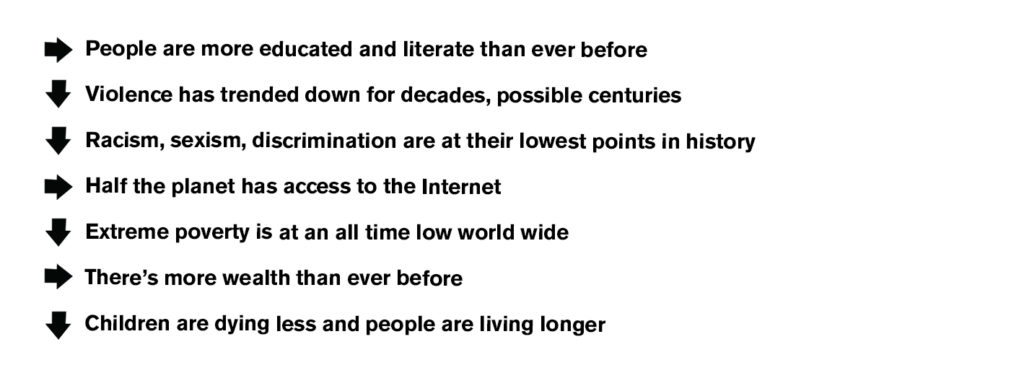
- People are more educated and literate than ever before
- Violence has trended down for decades, possibly centuries
- Racism, sexism and discrimination are at their lowest measurable points in history
- Half the planet has access to the internet
- Extreme poverty is at an all-time low worldwide
- There’s more wealth than ever before
- Children are dying less and people are living longer
While we’re in the safest and most prosperous time in history, we feel like everything is falling apart. That’s because with progress comes fear of loss.
The exceptional advances in technology, business and lifestyle have simultaneously raised our quality of life and heightened our awareness of what could be taken away. As our standards improve, our expectations rise. As systems become more interconnected, they appear more fragile.
> This is the paradox of progress.
Now Is Better
Stefan Sagmeister is not a statistician. He’s a designer.
For decades, he’s been one of the most provocative and influential figures in graphic design — known for album covers that feel like manifestos, typography carved into skin, and exhibitions that blur the line between art and psychology. Which makes his book Now Is Better especially compelling.
This book isn’t a dry academic argument. It’s visual and experiential. Charts become typographic compositions. Statistics are rendered as bold graphic statements. Data is transformed into artwork — making the case emotionally as well as intellectually. Sagmeister’s central insight is simple: our perception is distorted by proximity. We consume daily volatility and mistake it for long-term collapse. Zoom in, and you see chaos. Zoom out, and you see progress.
While there are many real challenges, he reframes them within the overall trajectory. Progress is happening — even when it doesn’t feel like it. And that tension between measurable improvement and emotional instability is precisely where the paradox of progress lives.
Progress forces us to make value judgments.

We judge the rightness, wrongness or usefulness of a new advancement based on a comparison to other things we already understand. These evaluations are often based upon limited information and are made quickly and impulsively. They are not universal. There are different evaluations because we don’t all agree on what is good or bad. Brands that leverage the paradox can use is persuasively.

This is why understanding the existing mindset of your market is essential. While you might be tempted to make your brand appeal to everyone, targeting a specific niche helps accelerate its adoption. It begins with identifying the people who have the most to lose without your offering. While the optimism of empowerment, delight and virtue are noble, the paradox is that motivation is driven by fear of loss.
The Big Three Paradox Motivators
Over the past decade, we’ve watched new behavioral patterns emerge as a byproduct of accelerated progress.

- FOMO — the Fear of Missing Out.
FOMO is social. It’s comparative. It’s fueled by visibility. As digital platforms expanded access to other people’s lives, experiences became broadcast in real time. Travel. Events. Success. Access. Status. When progress increases transparency, it also increases comparison. FOMO isn’t about scarcity — it’s about perception. It’s the anxiety of watching others participate in something you’re not part of. But as systems mature and opportunity becomes stratified, the anxiety evolves.= - FOLO — the Fear of Losing Out.
FOLO is less about what others are doing and more about maintaining position. It’s driven by limitation and supply constraints. Early access windows. Limited releases. Priority tiers. In a world where standards keep rising, losing access feels like regression. FOLO is protective. It’s about preserving advantage in an environment where expectations continually reset upward - FOBE — the Fear of Being Excluded.
FOBE operates at a deeper cultural level. It’s not about access to a product or experience — it’s about access to belonging. In a hyper-connected world, inclusion and exclusion are amplified. Identity, fairness, representation and legitimacy become central. FOBE reflects a fear of being outside the system entirely. It touches status, dignity and participation.
These aren’t simple marketing acronyms. They are symptoms of the same underlying dynamic: As progress expands opportunity, it simultaneously expands perceived risk.
The more we build, the more we stand to lose. The more connected we become, the more visible exclusion feels. The more advanced the system, the higher the emotional stakes. FOMO, FOLO and FOBE are simply modern expressions of the paradox of progress.
The Brand Strategy Paradox

The paradox of progress is a complex dynamic and is only one of the many elements that brands use to generate loyalty. While it’s valuable in establishing messaging, it must be combined with other communications strategies to generate reliable results. Used carelessly, excessive focus on fear and loss can result in brands that fail to inspire consumers over time. But when balanced with equal parts of vision and promise, the paradox is an important ingredient in motivating action.
The positive aspects the paradox invokes:
- Preservation — What am I trying to protect?
- Aspiration — What am I still reaching toward?
- Belonging — Who validates my version of progress?
Balanced correctly, these forces motivate action.
Surprising new data indicates that discretionary spending is up, fueled by a new mix of consumer demands. Technology continues to reshape how we work, shop and communicate. The pace of progress is showing no signs of slowing. Sagmeister’s reminder helps us zoom out and see improvement. But zoom in, and the stakes feel higher than ever. Both are true.
If you’re still thinking about your brand’s role in this environment, now’s the time to act. The world is in flux. Take the time now to assess your brand and prepare for progress.